
Call us
301-363-4651 (Available 9 a.m. to 5 p.m. CST from Monday to Friday)

| Code | CSB-RA010418A10phHU |
| Size | US$210 |
| Order now | |
| Image |
|
| Have Questions? | Leave a Message or Start an on-line Chat |
| Application | Recommended Dilution |
|---|---|
| WB | 1:500-1:2000 |
| ICC | 1:50-1:500 |
| IF | 1:30-1:200 |
Phosphorylation of Histone H3.1 at serine 10 represents one of the most dynamic chromatin modifications, serving as a critical marker of chromosome condensation during mitosis and playing essential roles in transcriptional activation of immediate-early genes. This modification acts as a molecular switch that influences chromatin structure and recruits downstream effector proteins, making it indispensable for studying cell cycle progression, mitotic events, and stimulus-induced gene expression programs.
This recombinant monoclonal antibody, produced from a defined clone sequence in rabbit host, offers the reproducibility that phospho-specific detection demands. Because phosphorylation states can be transient and context-dependent, having a sequence-defined reagent ensures that your experimental observations remain consistent across studies, eliminating the lot-to-lot variability that can confound longitudinal research or multi-site collaborations.
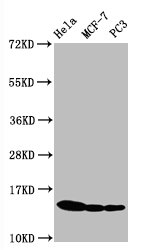
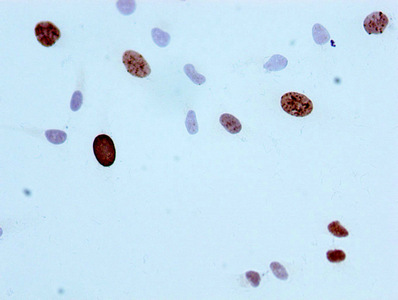
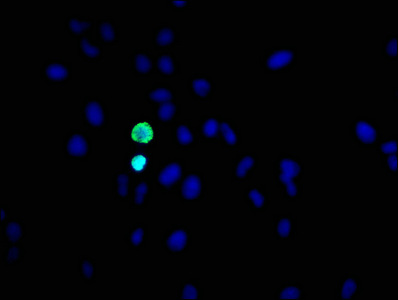
Validation across multiple detection platforms demonstrates this antibody's versatility in your experimental workflows. Western blot analysis confirms specific detection of the expected 15 kDa band in HeLa, MCF-7, and PC-3 whole cell lysates at working dilutions of 1:500–1:2000, providing reliable results across diverse human cancer cell models. For spatial analysis of mitotic populations, immunocytochemistry and immunofluorescence applications have been validated in HeLa cells, with immunofluorescence staining showing clear nuclear localization when counter-stained with DAPI—exactly the pattern expected for this chromatin-associated modification.
Whether you're investigating cell cycle checkpoints, characterizing mitotic abnormalities in cancer models, or exploring the interplay between histone phosphorylation and other epigenetic marks, this antibody provides a dependable tool for your epigenetics and nuclear signaling research.
There are currently no reviews for this product.





